Kenroku-en ( Six Attributes Garden), located in Kanazawa, Ishikawa, Japan, is an old private garden developed from the 1620s to 1840s by the Maeda clan, the daimyo who ruled the former Kaga Domain.
Along with Kairaku-en and Koraku-en, Kenroku-en is one of the Three Great Gardens of Japan. It is open year-round during daylight hours and famous for its beauty in all seasons; an admission fee is charged.
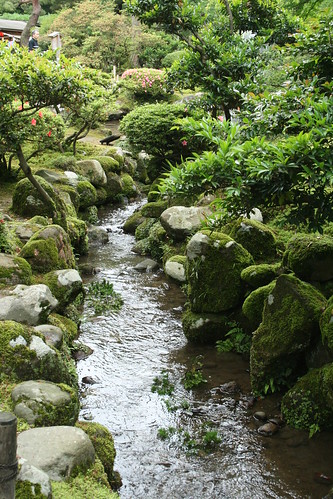
The garden is located outside the gates of Kanazawa Castle where it originally formed the outer garden, and covers 114,436.65 m² (over 25 acres). It began in 1676 when the 5th lord Maeda Tsunanori moved his administration to the castle and began to landscape a garden in this vicinity. This garden was, however, destroyed by fire in 1759. Its restoration was begun in 1774 by the 11th lord Harunaga, who created the Emerald Waterfall (Midori-taki) and Yugao-tei, a teahouse. Improvements continued in 1822 when the 12th lord Narinaga created the garden's winding streams with water drawn from the Tatsumi Waterway. The 13th lord Nariyasu subsequently added more streams and expanded the Kasumi Pond. With this, the garden's current form was complete. The garden was opened to the public on May 7, 1874.
The garden was named by Matsudaira Sadanobu at the request of Narinaga. Its name was derived from the "Chronicles of the Famous Luoyang Gardens" , a book by the Chinese poet Li Gefei , and stands for the six attributes of a perfect landscape: spaciousness, seclusion, artifice, antiquity, waterways, and panoramas.
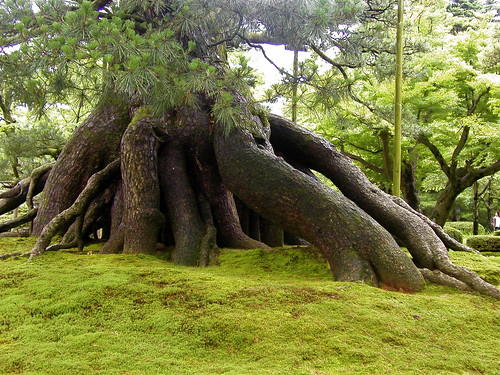
Kenroku-en contains roughly 8,750 trees, and 183 species of plants in total. Among the garden's points of special interest are
- the oldest fountain in Japan, powered by the difference in heights of two ponds
- Yugao-tei, a teahouse, the oldest building in the garden, built 1774
- Shigure-tei, a rest House that was originally built by the 5th lord Tsunanori, reconstructed at its present location in 2000
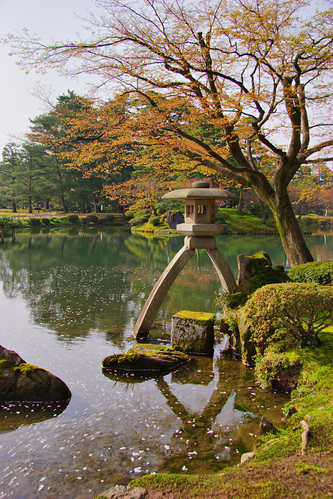
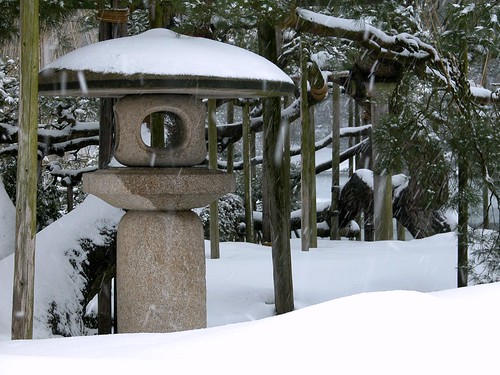
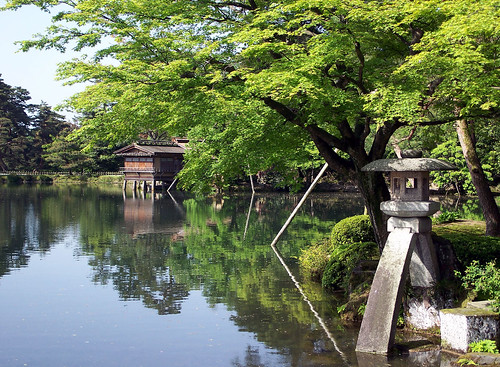
- Kotoji-tōrō, a stone lantern with two legs, said to resemble the bridge on a koto. This lantern is emblematic of Kenroku-en and Kanazawa.
- Flying Geese Bridge (Gankō-bashi), made of eleven red stones, laid out to resemble geese in a flying formation
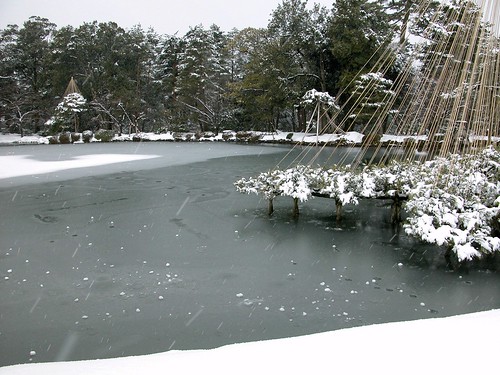
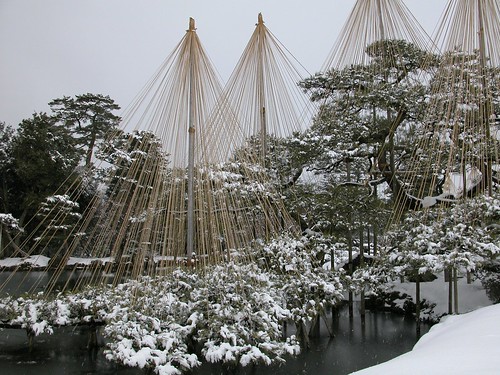
In winter, the park is notable for its yukitsuri — ropes attached in a conical array to carefully support tree branches in the desired arrangements, thereby protecting the trees from damage caused by heavy snows.


 from wikipedia.org
images from flickr users: teman, myproblogger, mambo1935, KimonBerlin, ambrosiamonkey, avsfan1321


